BOTE Lowrider Aero 11'6" Tandem vs BOTE Rackham Aero 12' Fishing Paddle Board: Spec Comparison
As an Amazon Associate we earn from qualifying purchases. Links on this page are affiliate links.
When comparing the bote lowrider aero 11 6 tandem vs rackham aero 12 fishing paddle board, you see two distinct inflatable platforms from BOTE. Both boards share durable inflatable construction and the brand’s Rac System for gear attachment. The main difference lies in their design intent. The Lowrider focuses on tandem versatility and hybrid paddling, while the Rackham is built specifically for fishing stability and heavy loadouts.
Key differences
| Aspect | BOTE Lowrider Aero 11'6" Tandem SUP Kayak | BOTE Rackham Aero 12' Fishing Paddle Board |
|---|---|---|
| Board Length | 11'6" | 12 FT |
| Board Width | 36 inches | 38 inches |
| Weight | 37 pounds | 44 pounds |
| Weight Capacity | not listed | 400LB |
| Primary Activity | Tandem/Hybrid | Fishing |
Which one should you choose?
Choose BOTE Lowrider Aero 11'6" Tandem SUP Kayak if
- You want a versatile board for solo or tandem paddling
- You prefer a lighter board that is easier to carry
- You need a hybrid platform for SUP and kayak use
Choose BOTE Rackham Aero 12' Fishing Paddle Board if
- You prioritize maximum stability for fishing gear
- You need a high weight capacity for heavy loads
- You want a board designed specifically for anglers
Verdict: The Lowrider Aero 11'6" is the better choice for paddlers seeking versatility and a lighter, more portable platform for shared adventures. The Rackham Aero 12" suits anglers who need a wider, heavier-duty board with a high weight capacity for fishing equipment. Your decision depends on whether you value hybrid flexibility or specialized fishing stability.
BOTE Lowrider Aero vs Rackham Aero
board length
The BOTE Lowrider Aero measures 11 feet 6 inches long, which equals 138 inches. The BOTE Rackham Aero is slightly longer at 12 feet, or 144 inches. This extra six inches on the Rackham can provide a marginally smoother glide in flat water. The Lowrider’s shorter length may feel more maneuverable for quick turns. Both lengths are substantial, offering good tracking for their respective designs. You should choose based on whether you prioritize the slightly longer glide path or the more compact footprint for handling.
board width
Width is a major differentiator between these two boards. The Lowrider Aero is 36 inches wide, providing a stable platform for tandem use. The Rackham Aero is wider at 38 inches. This additional width gives the Rackham a more planted feel, which is crucial when standing still to fish. The extra stability helps when casting or handling gear. If you are sharing the board or moving around with a passenger, the Lowrider’s width is sufficient. For solo fishing where stability is paramount, the Rackham’s wider stance offers a clear advantage.
weight capacity
The Rackham Aero supports up to 400 pounds, as stated in its key specifications. The Lowrider Aero does not list a specific weight capacity in the provided data. However, the Rackham is designed to carry a full fishing loadout comfortably. Its 38-inch width and 400-pound limit suggest it can handle heavier gear and larger anglers. The Lowrider is built for two people, so its capacity is likely high, but the exact number is not available. For carrying heavy fishing equipment, the Rackham’s stated limit provides confidence in its load-bearing capability.
board weight
When moving these boards, weight matters. The Lowrider Aero weighs 37 pounds. The Rackham Aero is heavier at 44 pounds. The Lowrider is seven pounds lighter, which makes it easier to carry, lift into a vehicle, or store. The Rackham’s extra weight likely comes from its wider profile and fishing-specific reinforcements. If you frequently transport your board alone, the Lowrider’s lighter construction is a practical benefit. The Rackham’s heft may require more effort during setup and takedown, though it contributes to its robust fishing platform feel.
fishing features
The Rackham Aero is purpose-built for fishing. It includes a recessed deck for better stability and a Sandspear sheath for rod storage. It also supports Power Pole Micro mounting. The Lowrider Aero focuses on versatility as a hybrid SUP and kayak. It includes seats and hybrid paddles, which are great for mixed use but less specialized for fishing. The Rackham offers dedicated fishing gear attachment points like MAGNEPOD Duo and KULA tie-downs. If your primary goal is fishing, the Rackham’s specialized features provide a significant functional advantage over the generalist Lowrider.
Choose the right board for you
Anglers needing max stability and gear space
The Rackham Aero offers a 38-inch width and a 400-pound capacity. This wide, stable platform handles heavy fishing loads with ease. Its 12-foot length aids tracking, while dedicated mounts like the Sandspear sheath and Power Pole compatibility keep your tackle organized and secure during long days on the water.
Pairs wanting tandem paddling or kayak conversion
The Lowrider Aero is built for two people. Its 11-foot 6-inch length and 36-inch width provide ample room for tandem use. It includes removable kayak seats and hybrid paddles, allowing you to switch between stand-up paddling and seated kayaking instantly. This versatility makes it ideal for shared adventures.
Solo paddlers prioritizing lighter transport weight
At 37 pounds, the Lowrider Aero is lighter than the Rackham Aero, which weighs 44 pounds. This reduced weight makes it easier for one person to carry and inflate. If you prioritize portability and do not need the extra 400-pound capacity or fishing-specific rigging, the lighter tandem board suits your needs.
The products compared

BOTE Lowrider Aero 11'6" Tandem SUP Kayak
Best for: tandem paddling and gear-heavy trips
- Board Length
- 11'6"
- Board Width
- 36"
- Construction
- Inflatable
- Dimensions
- 138 × 36 × 0.1 inches
- Weight
- 37 pounds
View on Amazon: BOTE Lowrider Aero 11'6" Tandem SUP Kayak Affiliate link
The BOTE Lowrider Aero is a 11'6" inflatable SUP and kayak hybrid. It measures 36 inches wide and weighs 37 pounds. This board includes removable kayak seats and hybrid paddles. Its Rac System and MAGNEPOD points allow for customizable gear setups. You will find it suitable for solo or tandem paddling on lakes, rivers, and bays.
Pros
- 11'6" length offers stability for tandem use
- 36-inch width provides ample standing space
- Includes removable kayak seats and hybrid paddles
- Features Rac System and MAGNEPOD attachment points
Cons
- 37-pound weight is heavy for single-person transport
- Inflatable construction requires setup time before use
- Limited to two size variations in the lineup
Good fit if
- You need a board for two paddlers
- You want to switch between SUP and kayak styles
- You require secure gear attachment points
Skip if
- You prefer a rigid board for performance
- You paddle alone and need lightweight gear
- You want a board under 30 pounds
Verdict: BOTE Lowrider Aero 11'6" Tandem SUP is a stable, versatile platform for shared adventures. It fits paddlers who value convertible seating and gear organization over portability.
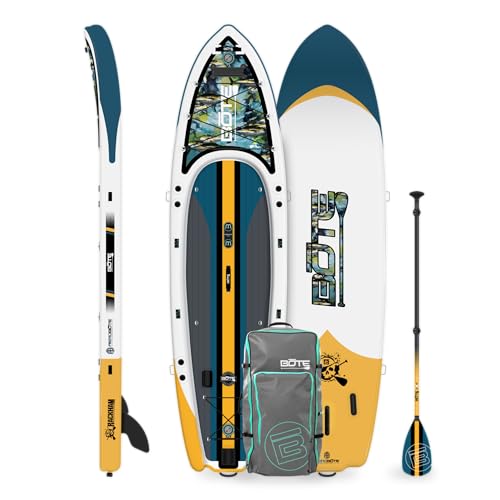
BOTE Rackham Aero 12' Fishing Paddle Board
Best for: Anglers needing high stability and gear capacity
- Board Length
- 12'
- Board Width
- 38"
- Weight Capacity
- 400 lbs
- Construction
- Inflatable
- Activity
- Fishing
- Dimensions
- 144 × 38 × 0.1 inches
View on Amazon: BOTE Rackham Aero 12' Fishing Paddle Board Affiliate link
The BOTE Rackham Aero is a 12-foot inflatable fishing paddle board built for stability. It measures 38 inches wide with a 400-pound weight capacity. This setup supports full gear loads on the water. The board includes Rac System receivers and MAGNEPOD Duo points for accessories. It weighs 44 pounds and packs into a rolling bag for easy transport.
Pros
- 38-inch width provides a stable platform
- 400-pound weight capacity for heavy gear
- Integrated MAGNEPOD Duo attachment points
- Rac System receivers for customization
- Includes rolling travel bag
Cons
- 44-pound weight is heavy for solo carrying
- Inflatable construction requires pump setup time
- No visible rod holder specs in data
Good fit if
- You need a stable base for fishing gear
- You plan to carry heavy tackle boxes
- You want accessory mounting options
Skip if
- You prioritize lightweight portability
- You want a rigid board for speed
- You only fish from shore
Verdict: BOTE Rackham Aero 12ft Fishing SUP is ideal for anglers who need maximum stability and gear capacity. It suits those willing to manage a heavier inflatable board for a solid fishing platform.
Specifications side by side
| Spec | BOTE Lowrider Aero 11'6" Tandem SUP Kayak | BOTE Rackham Aero 12' Fishing Paddle Board |
|---|---|---|
| Board Length | 11'6" | 12' |
| Board Width | 36" | 38" |
| Weight Capacity | not stated | 400 lbs |
| Construction | Inflatable | Inflatable |
| Activity | not stated | Fishing |
| Dimensions | 138 × 36 × 0.1 inches | 144 × 38 × 0.1 inches |
| Weight | 37 pounds | 44 pounds |
| Size | 11 FT 6 In | 12 FT |
| Color | Full Trax Harbor | Fischer Ahi |
| Model | 116iLR26FT | 120iRK26FA |
Frequently asked questions
Which board is heavier, the Lowrider Aero or Rackham Aero?
The BOTE Rackham Aero is heavier. It weighs 44 pounds, while the Lowrider Aero weighs 37 pounds. The extra seven pounds on the Rackham comes from its wider 38-inch design and additional fishing-specific features. You will notice the weight difference when carrying the board to the water.
Is the Lowrider Aero wider than the Rackham Aero?
No, the Rackham Aero is wider. It measures 38 inches across, compared to the Lowrider Aero’s 36-inch width. The additional two inches on the Rackham provide more stability for standing and casting. The Lowrider remains wide enough for two paddlers but is slightly narrower overall.
Can the Lowrider Aero fit two people comfortably?
Yes, the Lowrider Aero is designed for tandem use. It measures 11 feet 6 inches long, providing ample space for two paddlers. Its 36-inch width offers a stable platform for shared adventures. You can convert the seating to accommodate different riding styles or gear loads.
Does the Rackham Aero have a longer length than the Lowrider?
Yes, the Rackham Aero is longer. It measures 12 feet, or 144 inches, while the Lowrider is 11 feet 6 inches, or 138 inches. The extra six inches on the Rackham can improve tracking and speed. This length is beneficial for covering more water during fishing trips.
Are both boards inflatable construction?
Yes, both boards use inflatable construction. This design makes them durable and portable for storage. You can deflate them to fit in a car trunk or closet. The inflatable material provides a stable platform on the water while keeping transport manageable for most users.
Which board is better for heavy gear loads?
The Rackham Aero is better for heavy gear. It offers a 400-pound capacity and a wider 38-inch base for stability. The Lowrider Aero supports two paddlers but has a lower weight limit. If you need to carry coolers, rods, and other fishing equipment, the Rackham handles the load better.
What is the model number for the Lowrider Aero?
The model number for the Lowrider Aero is 116iLR26FT. This identifier helps you find replacement parts or verify specifications. It corresponds to the 11-foot 6-inch length and 36-inch width. Use this number when searching for accessories or comparing exact product details online.
Is the Rackham Aero suitable for fishing?
Yes, the Rackham Aero is specifically designed for fishing. It features a 12-foot length and 38-inch width for maximum stability. The board includes dedicated mounts for gear and accessories. Its 400-pound capacity allows you to carry heavy fishing equipment without compromising balance on the water.